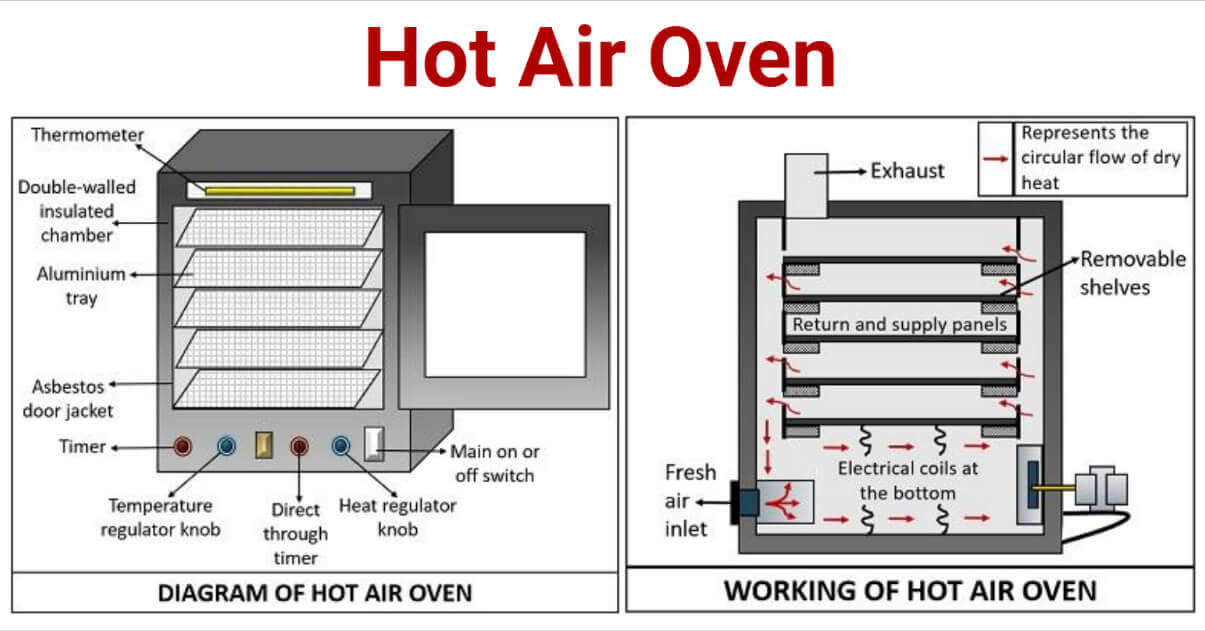
A Hot Air Oven (also known as a dry heat sterilizer or drying oven) is a widely used piece of equipment in biochemistry laboratories. It employs dry heat for sterilization, drying, and thermal processing of materials that are heat-resistant but cannot tolerate moisture (unlike steam autoclaves). In biochemistry labs, it plays a key role in maintaining sterility for glassware, tools, and samples, preventing contamination in experiments involving enzymes, proteins, DNA/RNA work, biochemical assays, media preparation, and reagent handling.
Principle of Operation
Hot air ovens work on the principle of dry heat sterilization through conduction, convection, and radiation:
Electric heating elements (usually at the bottom or sides) heat the air inside the insulated chamber.
Hot air circulates (naturally in gravity convection models or forced via fans in modern units) to distribute heat evenly.
Heat transfers to objects via conduction (direct contact), then penetrates inward.
Microorganisms are killed by:
Oxidative damage to cellular components.
Denaturation of proteins and enzymes.
Dehydration (evaporation of cellular water).
Elevated electrolyte toxicity inside cells.
This process is slower and requires higher temperatures/longer times than moist heat (autoclaving), but it’s ideal for moisture-sensitive items.
Standard sterilization cycles include:
160–170°C for 2–3 hours (common for complete spore killing).
180°C for 30–60 minutes (faster but still effective).
Removable perforated shelves/trays (aluminum or stainless steel) for holding items.
Thermostat/temperature controller (digital or analog).
Thermometer or digital display.
Timer.
Air circulation fan (in forced convection models for uniform heating).
Exhaust vent (for pressure release and fresh air intake).
Door with gasket (often asbestos-free modern versions).
Applications in Biochemistry
Hot air ovens are essential for:
Sterilization of heat-stable items:
Glassware (test tubes, flasks, Petri dishes, pipettes, beakers).
Metal instruments (forceps, spatulas, needles).
Dry powders (e.g., starch, agar, certain reagents).
Oils, petroleum jelly, or paraffin (used in some biochemical preparations).
Drying:
Removing residual moisture from washed glassware or samples before weighing or storage (critical for accurate biochemical assays).
Drying precipitates, crystals, or filters after washing.
Pre-drying samples for moisture-sensitive experiments.
Heat treatment / Annealing:
Preparing or activating certain biochemical reagents.
Curing or baking coatings on labware.
Thermal stability testing of enzymes, proteins, or compounds.
Other uses:
Evaporation studies or gentle heating of solutions (when moisture loss is acceptable).
Aging or stress testing of materials in research.
It is not suitable for:
Liquids or aqueous solutions (they would boil/evaporate).
Heat-labile materials (e.g., many plastics, rubber, media with nutrients).
Items requiring rapid or moist sterilization (use autoclave instead).
Modern biochemistry labs often prefer forced convection models for better temperature uniformity and faster recovery after door opening.
If you need details on SOPs, validation (e.g., biological indicators like Bacillus subtilis spores), specific models, or comparisons with other sterilizers, let me know!