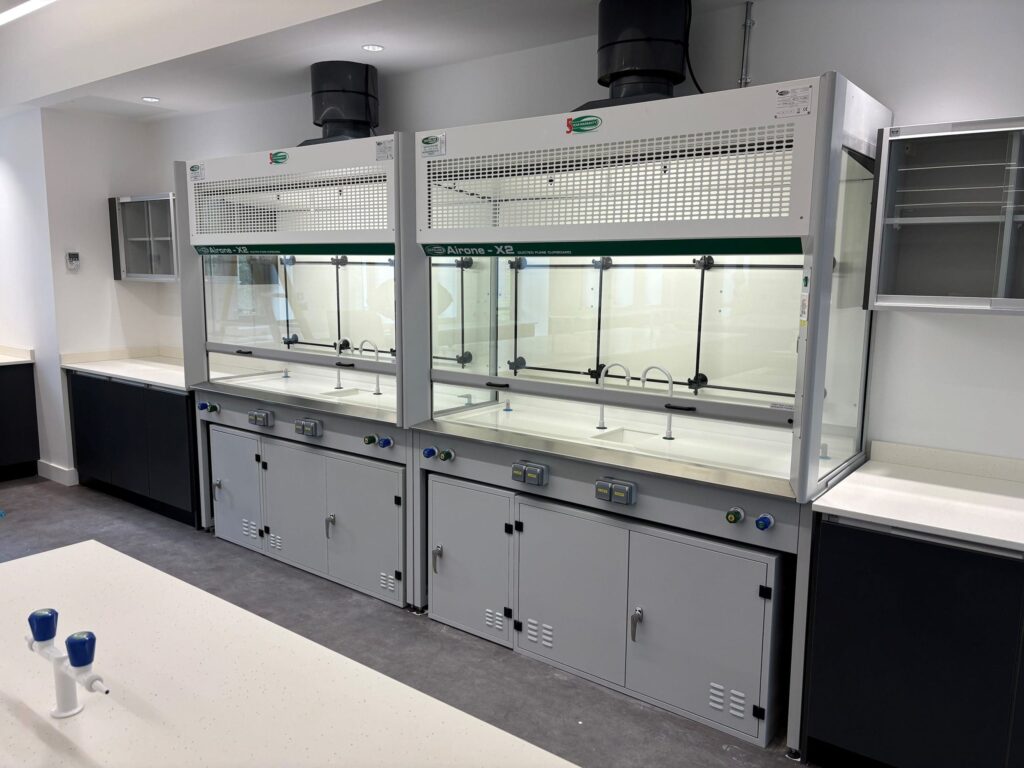
A ducted fume cupboard (also known as a ducted fume hood or ducted chemical fume cupboard) is a critical safety device in laboratories, particularly in chemistry, biochemistry, pharmaceutical, analytical, and research settings. It is a ventilated enclosure that protects users, the laboratory environment, and sometimes the experiment from exposure to hazardous fumes, vapors, gases, dust, aerosols, and toxic chemicals generated during procedures.
Principle of Operation
Ducted fume cupboards operate on negative pressure and local exhaust ventilation (LEV):
A powerful exhaust fan/blower (usually roof-mounted or remotely located) creates negative pressure inside the hood.
Air is drawn in through the open sash (sliding vertical or horizontal glass window) at the front, creating an inward airflow that captures contaminants at the source.
Contaminated air is pulled upward through baffles (to ensure even flow and prevent backflow), into the plenum, then through ductwork, and exhausted outside the building (often high above the roof to disperse safely).
This prevents recirculation of hazardous substances back into the lab, providing the highest level of protection for a wide range of chemicals, including highly toxic, volatile, or unknown compounds.
Key Components
Sash — Vertically or horizontally sliding safety glass for access and containment.
Work surface — Chemical-resistant (e.g., epoxy resin, ceramic, or polypropylene) with spill containment lip.
Baffles — Adjustable or fixed panels at the back/top for uniform airflow.
Airfoil — At the bottom and sides to reduce turbulence.
Exhaust duct — Connects to building HVAC/exhaust system.
Controls — Sash position sensors, airflow monitors/alarms, emergency shut-off, and sometimes VAV (Variable Air Volume) for energy efficiency.
Base cabinets — Often acid/corrosive/flammable storage with ventilation.
Main Uses in Laboratories
Ducted fume cupboards are the gold standard for handling:
Volatile organic compounds (VOCs), solvents, acids, bases, and reactive chemicals.
Perchloric acid or radioisotopes (specialized versions).
High-volume or high-hazard procedures (e.g., distillations, refluxing, synthesis, digestions).
Any work where unknown or highly hazardous substances are involved.
Pharmaceutical compounding, quality control testing, or handling potent APIs.
Biochemistry experiments involving volatile reagents or fume-generating reactions.
Advantages Over Ductless Models
Superior containment for virtually any chemical (no filter limitations).
No risk of filter breakthrough or saturation.
Handles unknown or highly hazardous substances safely.
Complies with strict regulations for toxic emissions.
Comparison: Ducted vs. Ductless
Ducted: Exhausts contaminants outside → Best for high-hazard, broad chemical use. Ductless: Filters and recirculates air → Suitable for low-volume, known low-toxicity work; easier install, energy-efficient, mobile.